50 Questions to Ask Your Grandparents Before It's Too Late
Nearly half of Americans (47%) regret not recording a conversation with someone who's no longer alive, according to a 2022 YouGov survey of 6,090 adults. Your grandparents carry stories you've never heard. First dances and wartime letters. The recipe nobody wrote down. These 50 questions to ask your grandparents will help you start the conversations that matter most before they're no longer possible.
Why You Need to Record Your Grandparents' Stories Now
Your grandmother who makes the same potato soup every Sunday has never explained why. She learned that recipe from her mother during the Depression, when potatoes were all they could afford. That soup is a survival story disguised as comfort food. And without asking, you'll only ever know it as soup.
The numbers paint a blunt picture. A 2022 Ancestry Heritage Survey found that 53% of Americans can't name all four grandparents. Only 4% can name all eight great-grandparents. Aaron Holt of the National Archives sums it up: "It only takes three generations to lose a piece of oral family history."
Dr. Karl Pillemer at Cornell spent ten years interviewing over 1,000 Americans past age 65 for his Legacy Project. Their most common advice to younger people wasn't about money or careers. It was simpler than that: don't wait to ask the questions.
There's a medical case for recording too. A 2023 meta-analysis in Frontiers in Psychiatry found that structured storytelling measurably reduces depression in older adults and improves life satisfaction. Recording your grandparents' stories preserves them for the family. It also genuinely benefits the person doing the telling.
But only 33% of Americans have actually recorded a conversation to preserve someone's memory. The other two-thirds keep meaning to. For a step-by-step guide to the full preservation process, see How to Preserve Family Stories Before It's Too Late.

Questions About Childhood and Growing Up
1. "What's your earliest memory?"
The answer is almost never what you'd expect. One grandfather's earliest memory was the smell of paint in a hardware store. A grandmother's was rain on a tin roof. These small sensory fragments become the emotional anchors of an entire memoir.
2. "What was your house like when you were a child?"
This pulls out details that disappear first: the creak of a specific staircase, wallpaper in a shared bedroom, the smell of a kitchen on Sunday mornings. Physical memory stays vivid long after names and dates fade.
3. "What games did you play, and who did you play with?"
Reveals the neighborhood and how children spent time before screens. Your grandfather chasing fireflies in 1952 is a world that exists only in his memory now.
4. "What was your school like?"
Education varied wildly by era and region. A one-room schoolhouse in rural Kansas and a Catholic school in Brooklyn in the same decade were entirely different planets (and both grandparents probably think their version was normal).
5. "Who was the most interesting character in your neighborhood?"
Every neighborhood had one. The answers are consistently better than fiction.
6. "What did you eat for dinner most nights?"
Food memories are cultural history. What a family ate in 1955 tells you more about their economic reality than any direct question about money would.
7. "What got you in trouble as a kid?"
Mischief stories are universally the most vivid childhood memories. And the ones grandparents enjoy telling most.
8. "What was the first thing you saved up to buy with your own money?"
Reveals both the era's economics and the person's earliest sense of what mattered to them. A bicycle in 1958 cost a summer of odd jobs.
Questions About Family History and Roots
9. "Where did our family come from originally?"
Migration stories are the spine of most family histories. The details your grandparent remembers may not exist in any written record anywhere.
10. "What do you know about your own grandparents?"
This question tests the three-generation rule directly. Whatever they can't answer is proof of what's already been lost.
11. "Was there a family secret that came out later?"
Handle this one gently. But most families have at least one (and it's usually less scandalous and more human than anyone expected).
12. "What language did your parents speak at home?"
Over 200 languages have gone extinct in the last three generations, according to UNESCO. The words your great-grandparents used at the dinner table (the idioms and pet names, the way they counted on their fingers) may be part of a vanishing tradition.
13. "What was the neighborhood like where you grew up?"
Place shapes identity in ways people don't realize until the place is gone. A demolished block or a neighborhood that gentrified beyond recognition.
Your stories are saved on your device and in iCloud. AI and book creation send selected text and photos to our service. Our service also stores book manuscripts and the original story text so you can edit your book.
15. "What's the oldest family photo you've ever seen, and who was in it?"
A single old photograph can open an entire branch of the family tree that nobody has discussed in decades.
Questions About Love, Marriage, and Relationships
16. "How did you meet [your spouse/partner]?"
Your grandparents think they've told this story. They haven't told the real version with the details that only surface when someone genuinely asks.
17. "What was your wedding day like?"
Beyond the photos, there are details nobody preserved: what the weather was, what went wrong, who almost didn't make it there, what the photographer missed.
18. "What's the best advice anyone gave you about marriage?"
The advice that stuck is always specific. Something concrete that shaped how they handled a real situation decades later.
19. "What was the hardest year you and [spouse] went through together?"
Real relationships have hard chapters. These stories reshape how a family understands what actually held it together.
20. "Who was your first crush?"
This question reliably produces the best laugh in any recording session. Grandparents light up.
21. "What do you wish you'd known about love at 20?"
The distance between 20 and 80 produces answers that are genuinely useful (and often surprisingly blunt).
22. "What's a small thing [spouse] did that you never forgot?"
A woman discovered her grandfather had recorded every date with his wife for over 60 years. Tuesday, fish and chips at the corner place. The ordinary details became the most extraordinary ones after he passed. Ask about the small things.
Questions About Work, Career, and Money
23. "What was your very first job?"
Almost always a good story. The pay and the boss. First jobs are character-forming in ways people underestimate.
24. "What job taught you the most, even if it wasn't the best?"
Better than "what was your career" because it targets a specific memory rather than a resume recitation.
25. "How much did things cost when you started working?"
Concrete economic history that never appears in textbooks. What rent was, what a car cost, what a week of groceries ran, what a movie ticket went for. These numbers ground a story in its era.
26. "Did you ever almost go into a completely different line of work?"
Roads not taken are some of the most revealing stories anyone can tell. The business they nearly started, the opportunity they walked away from.
27. "What was the worst boss you ever had?"
Everyone has one. And the stories are consistently the funniest material in any family recording session.
28. "How did you decide what to do for a living?"
Career planning was a different animal 50 years ago (if it existed at all). Some people fell into their life's work entirely by accident.
29. "What would you tell a young person starting out about money?"
Direct, practical wisdom earned over decades. The answers are rarely what financial advisors would say.
Questions About Adventures and Travel
30. "What's the farthest from home you've ever been?"
The scale of someone's world tells you a lot about their generation and circumstances. For some grandparents, the next state was a big trip.
31. "Tell me about a trip that didn't go as planned."
Disaster stories are the ones families retell for decades. The flat tire in the desert, the hotel that turned out not to exist, the ferry they missed by two minutes.
32. "Did you ever live somewhere completely different from where you grew up?"
Relocation stories carry an emotional weight that vacation memories don't. Leaving home is its own kind of adventure.
33. "What place do you wish you could visit one more time?"
Nostalgia mapped to geography. The answer reveals what mattered most across a lifetime of places.
34. "What's the most unexpected thing you ever did?"
Give them permission to be young again in the telling. The stories that come from this question are rarely the ones you'd predict.
35. "Did you ever get completely lost somewhere?"
Getting-lost stories are universal. They're almost always funny in retrospect.
36. "What's a meal you ate somewhere that you still think about years later?"
Food and place fuse into some of the most durable memories humans form. A bowl of soup in a train station in 1968 can hold a whole world inside it.
Questions About Hard Times and Resilience
37. "What's the hardest thing you've ever lived through?"
Build trust over several sessions before asking this one. It requires a relationship where your grandparent already feels heard and safe.
38. "How did your family handle money during tough times?"
Practical survival strategies that passed down orally. These stories are often more useful than any personal finance book.
39. "Was there a moment when you genuinely thought things wouldn't work out?"
Vulnerability is rare in grandparent conversations. This question makes space for it without forcing it.
40. "Who helped you through your worst time?"
The answer is almost always a specific person, not an institution or a program. These stories reveal the relationships that actually held a life together.
41. "Did you ever have to start completely over?"
Reinvention stories carry a specific kind of courage. The details of rebuilding are worth preserving.
42. "What did your parents teach you about getting through hard times?"
This reaches back one more generation, capturing advice that might disappear entirely if nobody records it now.
43. "Is there something difficult you've never talked about but would be willing to now?"
The open door. Give permission and accept any answer, including silence. Some of the most important recordings start with this question.
Questions About Wisdom, Regrets, and Legacy
44. "What do you know now that you wish you'd known at 25?"
This question gets shared more than any other when families post their recordings online. Answers range from "save more money" to "worry less about what people think."
45. "What are you proudest of in your life?"
The answer is rarely a career achievement. It's almost always about family or a quiet moment of character that nobody else noticed at the time.
46. "What's your biggest regret?"
Handle with care. But regret stories teach the most about what a person truly valued.
47. "What do you want your grandchildren to remember about you?"
Save this for when trust runs deep. It often produces tears. The answers are always about character: "That I was fair." "That the door was always open." These are words grandchildren carry for the rest of their lives.
48. "If you could go back and relive one day, which would it be?"
Reveals what genuinely mattered across a life of thousands of days. The answer is almost never what you'd guess.
49. "What would you tell your younger self?"
Different from #44 because it's directed at themselves rather than at knowledge in general. The answers tend to be more personal and more raw.
50. "Is there anything you've always wanted to say that nobody has ever asked you about?"
End with the open door. The most powerful family recordings sometimes come from this single question, because it lets the storyteller choose what matters. If you're looking for a meaningful gift to give alongside these conversations, a recorded memoir makes the kind of Father's Day gift that nothing store-bought can match.

How to Record Your Grandparents' Stories
StoryCorps has collected conversations from over 700,000 participants since 2003. Their Great Thanksgiving Listen program alone has captured 150,000 intergenerational interviews. Millions of families are already recording stories like this.
Here's how to do it well:
1. Pick a quiet afternoon. Skip the holiday dinner with 15 people and a football game on. A Tuesday at 2 PM works better. The kitchen table is the best recording studio most families will ever need.
2. Start with childhood questions. Questions 1 through 8 from the list above consistently produce the warmest, most detailed responses. Psychologists call the period between ages 10 and 30 the "reminiscence bump," when the brain forms its most vivid long-term memories.
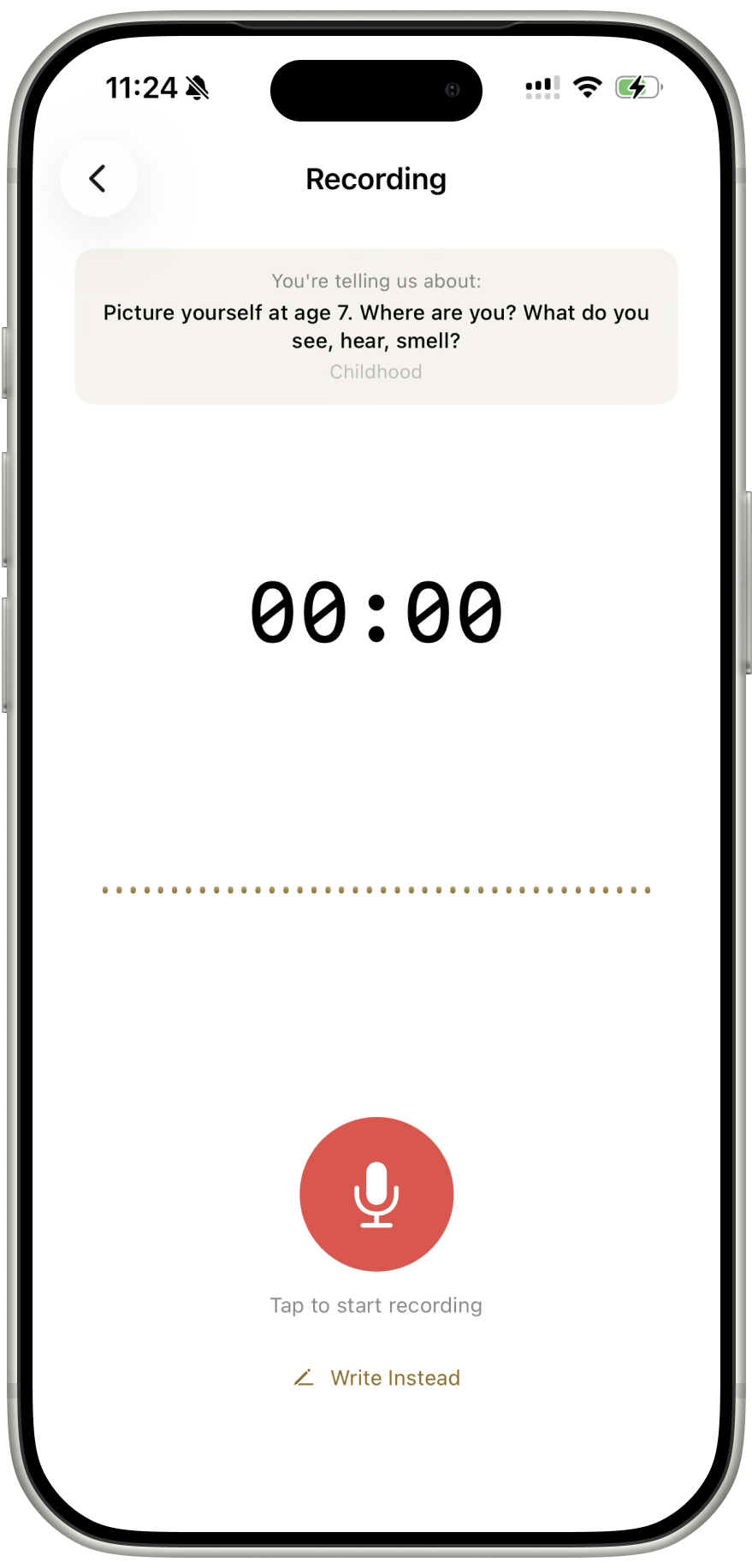
3. Use voice, not text. A person speaks 130 to 150 words per minute. They type 40. In a 15-minute session, voice captures over 2,000 words while typing produces about 600. And voice preserves what text never can: tone and laughter, the catch in someone's voice when they mention a sibling who passed young. Tell Me Your Story is built for exactly this kind of recording. It transcribes automatically and organizes stories into life chapters. It works in six languages, so your grandparent just talks while the app handles the rest.
4. Keep sessions to 15-20 minutes. Memory tires fast in people over 70 (and a tired storyteller gives surface-level answers). Five short sessions across a month produce richer material than one exhausting two-hour marathon.
5. Follow the tangents. If your grandfather mentions he worked on a fishing boat one summer at 17, don't redirect him back to your list. That tangent is a chapter no prepared question would have uncovered. The unplanned stories are almost always the best material.
How to Turn Recorded Stories Into a Family Keepsake
Digital recordings are convenient but invisible. They sit in cloud folders until a phone upgrade or a forgotten password wipes them out. A physical book sits on a shelf. It gets picked up at Thanksgiving and read aloud at funerals. Eventually, it gets inherited.
Try Tell Me Your Story
Learn what Tell Me Your Story does, browse features, and get support resources.
Frequently Asked Questions
- How do I get my grandparent to open up about the past?
- Start with happy childhood memories and use family photos as conversation starters. Don't call it "recording your life story" because that phrase makes people self-conscious. Try "Tell me about this photo" instead. Most grandparents open up once they realize you're genuinely interested, not just checking a box.
- What if my grandparent has memory loss or dementia?
- Record what they can share now. Even partial stories have real value. Use photographs and familiar objects to trigger memories. Short sessions of 5 to 10 minutes work better than long ones. Some people with early-stage dementia recall childhood events vividly even when recent memory is impaired.
- How many questions should I ask in one session?
- Three to five. Don't treat it as an interview with a checklist. Pick one section from the list and start with a single question. Let the conversation go wherever it goes. One good question followed by "tell me more about that" produces better material than rattling through fifteen.
- What's the best way to record my grandparent's voice?
- A smartphone placed between you on the table works well. Press record and forget about it. Dedicated memoir apps add transcription and chapter organization automatically, but any voice recorder app will capture the conversation. Focus on the person, not the technology.
- Is it too late if my grandparent is in their 90s?
- If they can still speak and remember, it's not too late. Even a single vivid story is worth preserving on its own. Some of the richest recordings come from people in their 90s who've had decades to distill what genuinely matters from what doesn't.
- What questions should I avoid asking elderly grandparents?
- Don't lead with trauma or deeply personal questions before building trust. Start with easy topics like childhood and food before approaching loss or family conflict. Respect silence when it comes. Sometimes the stories that matter most surface on their own, without any prompt at all.

Written by
James WhitfieldFamily Storytelling Advocate at Tell Me Your Story
James Whitfield is a family storytelling advocate and technology writer focused on digital tools that bridge generations. With a background in gerontology and ten years covering elder-friendly technology, James helps older adults and their families navigate the world of apps, devices, and digital preservation.