How to Interview Your Parents About Their Life Story (2026)
To interview your parents about their life story, pick a comfortable setting they know well, prepare 6-8 open-ended questions, and record the conversation on your phone. A single 40-minute session captures roughly 5,200 words of transcript, enough for a full chapter of a memoir. Here are six steps that work, based on oral history methods used by the Smithsonian Institution and StoryCorps.
Step 1: Choose the Right Time and Place
Your parents will share more in a familiar setting. Their living room beats a coffee shop. Their kitchen table after Sunday dinner beats a scheduled Tuesday afternoon where the conversation feels like a job interview.
Ruth Lang, a professional genealogist featured in Family Tree Magazine, says the sweet spot is relatives in their 50s through 70s, old enough to reflect meaningfully, young enough for sharp recall. But don't overthink timing: if your parent is 85, today is the right day.
Avoid holidays with a full house. The noise kills the recording, and the emotional energy of a big gathering makes people perform instead of remember. Pick a quiet afternoon when it's just you and one parent. (More on why "one parent" matters in the Mistakes section below.)
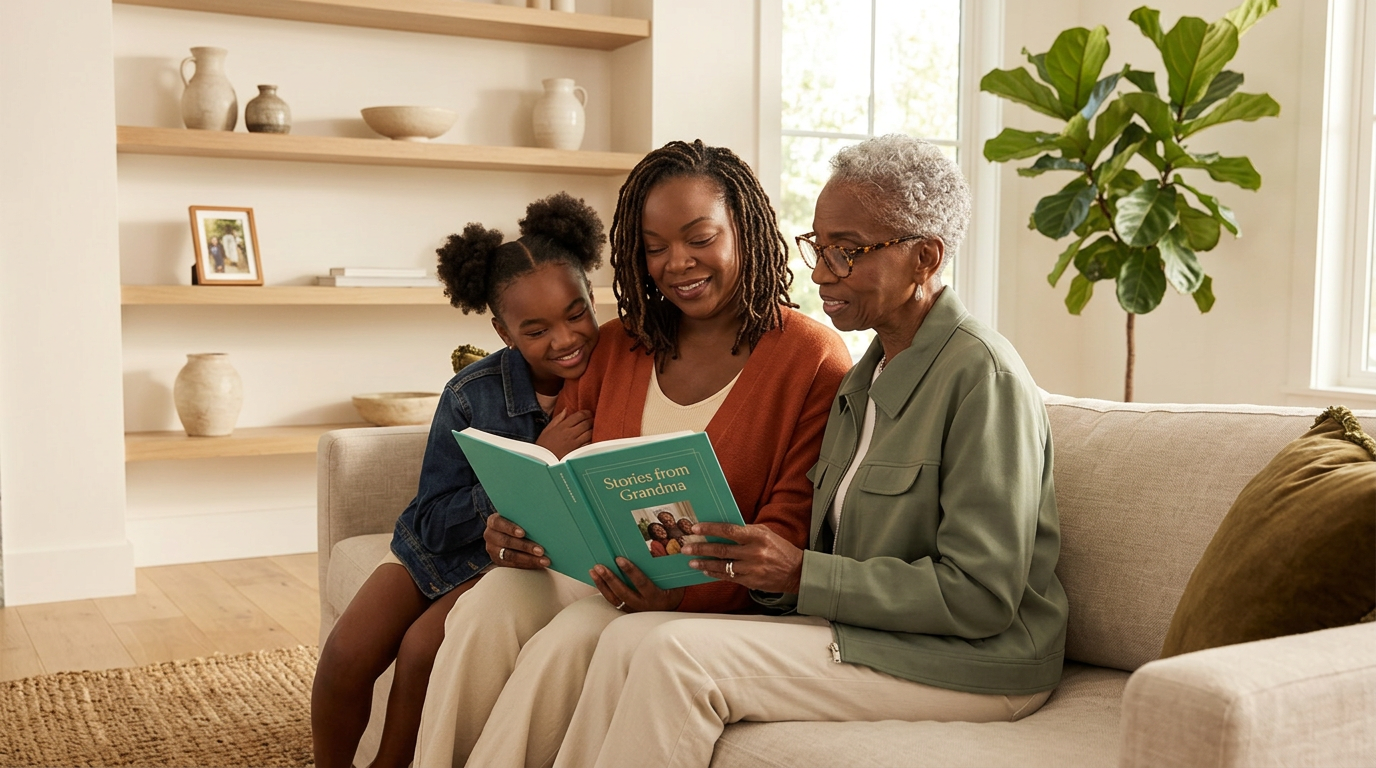
Bring a printed photo album or a family artifact. Objects trigger stories that abstract questions never will: your mom's wooden spoon, your dad's old watch, a faded Polaroid of their first apartment. Put it on the table and ask "tell me about this."
Step 2: Prepare 6-8 Open-Ended Questions
StoryCorps, which has archived over 600,000 conversations at the Library of Congress, recommends 6-8 prepared questions for a 40-minute interview. That sounds like too few. It's exactly right. An open-ended question like "Tell me about your first job" can fill 10 minutes on its own. "Did you like your first job?" gets a one-word answer and an awkward silence.
Don't ask about stories you've already discussed informally. One contributor on Ask MetaFilter put it directly: "Don't blow your wad before the tape is rolling. If you discuss stories beforehand, the taped version will be dry because they've expended all the emotional freshness in the first telling." Save the good questions for the recording.
If you need question ideas, we've published lists for specific family members. 50 questions to ask your grandparents and 50 questions to ask your mom cover different relationship angles with questions organized by life chapter.
Good starter questions that open people up:
- "Tell me about the house you grew up in."
- "What's something you believed as a child that turned out to be wrong?"
- "What's the hardest decision you ever made?"
- "Tell me about your parents' relationship."
Start with childhood. It's comfortable, distant enough that people open up without feeling exposed, and almost always leads somewhere unexpected.
Step 3: Set Up Your Recording
Place your phone on the table between you, screen down, and test a 30-second recording before your parent starts talking. Play it back. If you can hear the refrigerator hum louder than the voice, move rooms.
Shanna Farrell, an oral historian at UC Berkeley's Bancroft Library, recommends dedicated recording devices over phones because "you just don't know where those recordings are going in the cloud." That's a fair concern. If privacy matters (and with family stories, it absolutely should), choose an app that stores recordings locally or in your personal iCloud rather than on a company server. Our guide to voice recording covers the full range of options.
Your stories are saved on your device and in iCloud. AI and book creation send selected text and photos to our service. Our service also stores book manuscripts and the original story text so you can edit your book. Voice Memos on iPhone works too if you just want a raw audio file. The key is to actually test your setup before the conversation begins. Nothing kills momentum like "wait, I don't think it was recording."
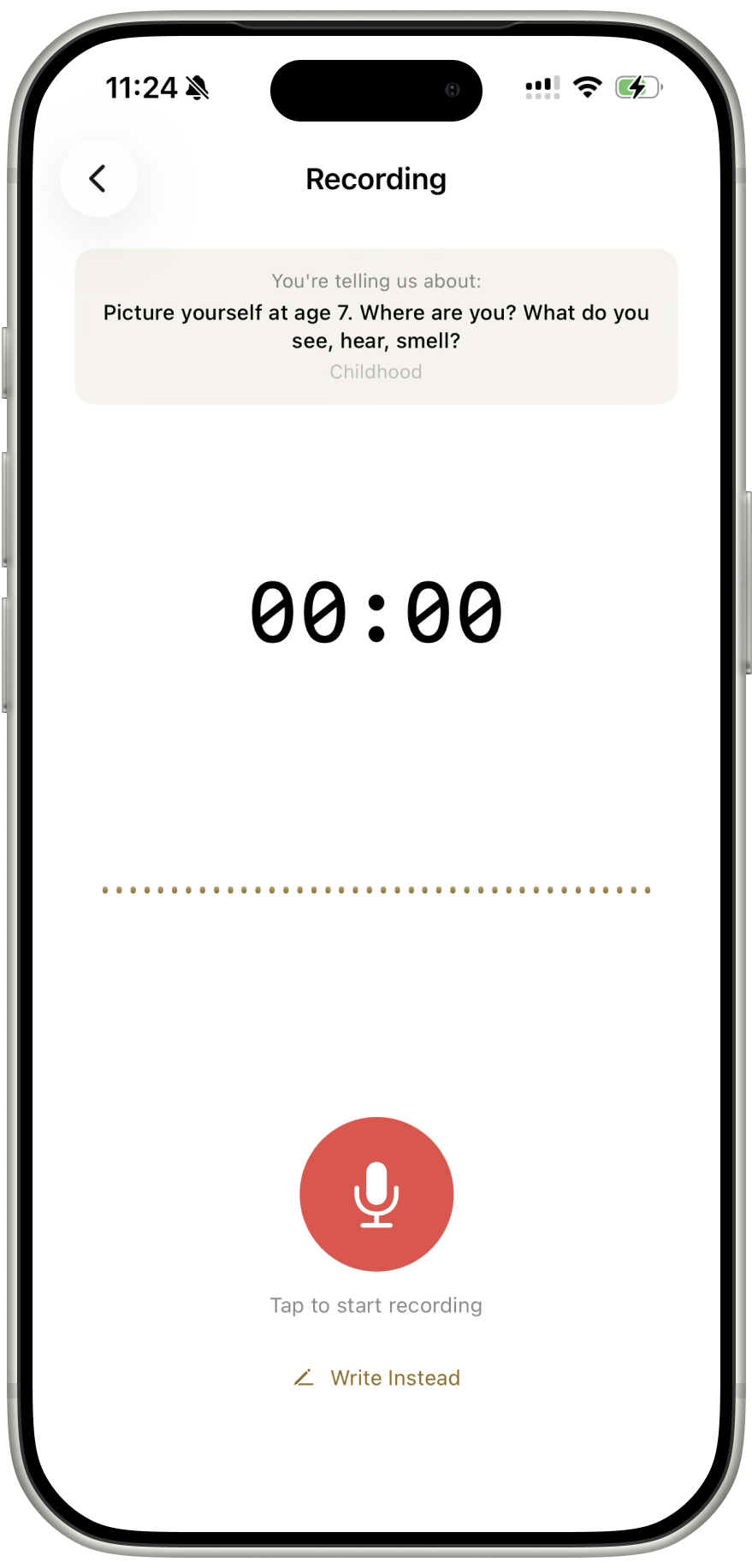
A single 40-minute recording captures about 5,200 words of transcript. That's a full chapter. Don't aim for marathon sessions. The Smithsonian Institution's oral history guidelines recommend 40-60 minute blocks with breaks between sessions.
Step 4: Listen More Than You Talk
The Smithsonian's guidance is blunt: "An interview is not a dialogue. The whole point of the interview is to get the narrator to tell her story. Limit your own remarks to a few pleasantries to break the ice, then brief questions to guide her along."
This is harder than it sounds. Your dad says something about the summer of '78 and you want to ask three follow-up questions at once. Resist that urge and let the pause sit. Research published in Social Neuroscience found that when speakers perceive active listening, they share more willingly and produce richer, more detailed stories. Your silence is doing the work.
Use these four phrases and little else:
- "Tell me more about that."
- "What happened next?"
- "How did that feel?"
- "Can you describe what you were seeing?"
When Amitt Mahajan interviewed his mother for six hours over two days (he wrote about the experience on Medium), he found that pressing further always beat staying neutral: "sometimes the questions were originally misunderstood." If an answer feels thin, ask the question again from a different angle. You won't offend anyone by being curious.
Step 5: Follow Up and Go Deeper
One session won't cover everything. And it shouldn't. Experienced interviewers on Ask MetaFilter warn that "interviewing is exhausting for everyone," recommending no more than one hour-long session per week.
Schedule a second session before you leave the first one with something concrete: "Can we do this again next Sunday? I want to hear about that summer you mentioned." That always works better than a vague "let's do this again sometime."
Between sessions, listen to the recording and write down three specific follow-ups. Not "tell me more about your childhood" but "you mentioned a neighbor named Frank who taught you to fish. What else do you remember about him?" Specific questions get specific answers.
Your dad who worked construction for 40 years has stories about the '94 earthquake cleanup, the foreman who taught him to weld, the house he built for your mother, the accident he never told anyone about.
But ask him "What was your career like?" and he'll say "It was fine." The right question: "Tell me about your first day on that construction crew."
Step 6: Preserve and Share What You Captured
A recording on your phone is better than nothing. It's also fragile in a way most people don't think about until it's too late: one accidental deletion and that conversation is gone forever. Back up every recording the same day you make it.
For transcription, you've got options from free to paid. Otter.ai offers 300 free transcription minutes per month (30 minutes per conversation on the free plan). Google Docs has built-in voice typing. But raw transcripts read rough, full of filler words and half-finished sentences that make your eloquent parent sound incoherent on paper. Some memoir apps handle transcription and AI polish in one step, cleaning up the text while keeping your parent's natural voice intact.
If you want to go from recordings to a physical book, that path exists. Our step-by-step memoir writing guide covers the full process, and our guide to preserving grandparents' memories walks through the digital-to-physical spectrum in detail.
The important thing: don't wait for a perfect system. Record something this week. Organize it later.
Common Interview Mistakes to Avoid
Interviewing both parents at the same time. One person always dominates while the other edits themselves, even when both swear they won't. Do separate sessions first and get each person's individual story on record. Then bring them together for shared memories, where their different versions of the same event make for some of the best material you'll capture.
Asking yes-or-no questions. "Did you enjoy school?" gets "Yeah, it was okay." Compare that with "What do you remember about your favorite teacher?" which gets a story about Mrs. Patterson who stayed after class to teach your dad algebra before his GED exam.
Discussing stories before you record. The first telling carries emotional weight that evaporates by the second retelling. When your mom tells the story about meeting your dad for the second time, she'll summarize instead of reliving it. Save the stories you most want to capture for when the recording is running.
Running marathon sessions. Fatigue sets in after 45-60 minutes. Your parent stops remembering and starts performing. Keep sessions short and come back often.
Waiting for the "right time." 44.2% of Americans have lost at least one parent, according to U.S. Census Bureau data. By age 50, 69.2% have lost their father. These aren't abstract numbers if your parent is in their 70s or 80s. The right time is this weekend, not next month when things calm down, because things never calm down.
Tools and Resources for Family Interviews
| Tool | Best For | Price |
|---|---|---|
| Voice Memos (iOS) | Quick capture, zero setup | Free |
| StoryCorps App | Guided interviews, archived at Library of Congress | Free |
| Otter.ai | Real-time transcription during the interview | Free (300 min/mo), Pro $8.33/mo |
| Scrivener | Organizing lengthy transcripts into narrative | $49-$59 one-time |
| Zoom | Remote interviews with distant parents | Free (40 min), Pro $13.33/mo |
| Google Docs | Writing up notes and transcripts after | Free |
Your parents' stories don't require professional equipment or a free weekend you'll never find. All they need is a phone, a quiet room, one good question, and about forty minutes. Pick one parent and start this week. The recording you make at your kitchen table this Sunday will matter more to your family than the one you keep planning to make next year.
Try Tell Me Your Story
Learn what Tell Me Your Story does, browse features, and get support resources.
Frequently Asked Questions
- How long should a family interview be?
- Keep sessions between 40-60 minutes. The Smithsonian Institution recommends this range based on decades of oral history work. Fatigue sets in after about an hour and story quality drops noticeably. Plan multiple shorter sessions rather than one long marathon.
- Should I interview my parents together or separately?
- Interview each parent separately first, then do a joint session for shared memories. When couples are interviewed together, one person tends to dominate while the other self-edits. Individual sessions capture each person's unique perspective and memories that might get censored in front of a spouse.
- What if my parent doesn't want to be interviewed?
- Skip the formal invitation entirely. Instead of "Can I interview you?", try "Mom, tell me about that apartment you lived in before I was born." Most people warm up once they realize you're genuinely curious, not checking a box. If they still resist, ask to look through old photos together while you quietly record.
- What equipment do I need to interview my parents?
- A smartphone with a recording app is enough to start. Place it between you on the table, screen down, and do a 30-second test recording first. For better audio quality, sit in a quiet room away from kitchen appliances and televisions. Tell Me Your Story or Voice Memos on iPhone both work well.

Written by
James WhitfieldFamily Storytelling Advocate at Tell Me Your Story
James Whitfield is a family storytelling advocate and technology writer focused on digital tools that bridge generations. With a background in gerontology and ten years covering elder-friendly technology, James helps older adults and their families navigate the world of apps, devices, and digital preservation.